
The New Era of Advertising: AI-Powered Commercial Film
- Adverjoy
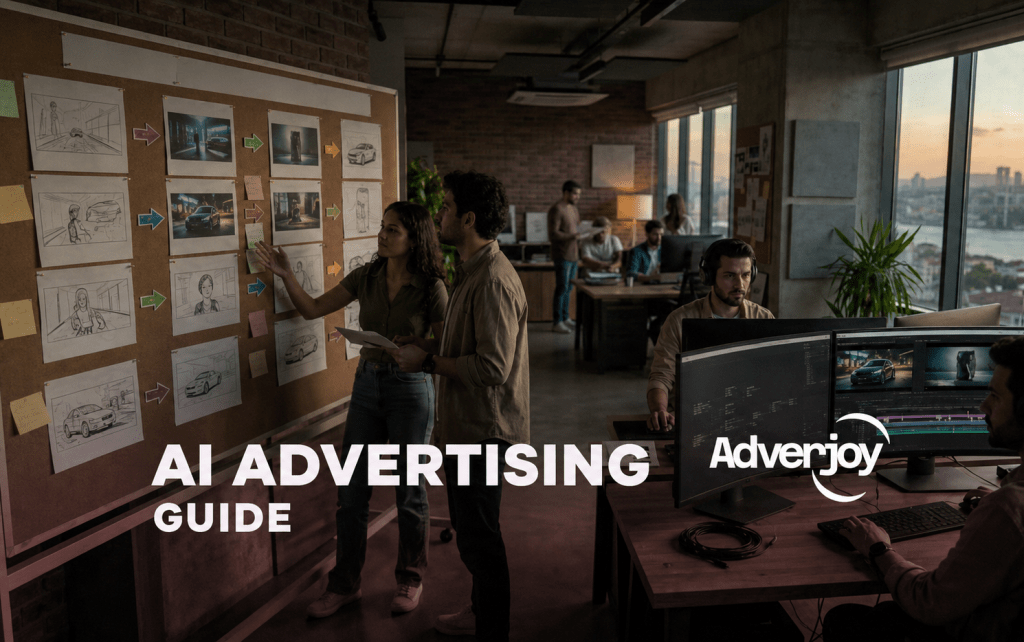
Advertising is the way a brand communicates its product, service, or value proposition to a target audience through a defined strategy. Its purpose is not only to deliver a message, but also to create perception, emotion, and action.
In the past, producing a commercial film meant long meetings, large production teams, high costs, and delivery timelines that could stretch across weeks. Traditional commercial production depends on many physical parameters, including set design, equipment, actors, locations, production crews, and complex shooting schedules.
Today, with the rapid development of artificial intelligence technologies, commercial film production can be carried out through increasingly digital production workflows. AI-supported systems allow brands to develop concepts faster, test visual directions earlier, and adapt campaigns across multiple formats with greater speed.
Digital advertising is no longer only about visibility. Speed, platform adaptability, testing, and continuous improvement have become just as important as creativity. This is exactly why AI commercial production has opened a new era for brands.
This does not mean traditional production is over. But it does make one thing clear: not using AI in advertising production has become a serious competitive disadvantage.
In this guide, we will examine what AI advertising is, how AI commercials are produced, which brands can benefit most, what advantages this model offers, and what brands should pay attention to during the process.
What Is AI Advertising?
AI advertising refers to commercials in which some or all production stages are supported by artificial intelligence tools. These stages may include script development, visual production, scene design, voice-over, editing, format adaptation, and in some cases, character animation.
The important point is this: artificial intelligence is not a magic production engine by itself. Without the right brief, creative direction, and brand language, it cannot produce a strong result.
The best outcome usually comes from a hybrid model, where human creativity and AI-driven production speed work together.
Today, many brands use AI for:
- Concept visualization before commercial production
Storyboard and moodboard development
Product-focused short video production
Vertical video variations for social media
Campaign adaptation across different languages and formats
Multiple creative versions for testing
How Are Commercials Produced with AI?
AI-powered commercial production is a new production model in which creativity and strategic control remain in human hands, while many visual, audio, and technical production processes are carried out through AI systems.
In this model, production is managed through digital production parameters rather than physical production constraints.
In simple terms, an AI commercial is produced by systematically creating the visual, audio, character, environment, and atmospheric elements of a commercial using AI production technologies, and then preparing the final film for release through professional post-production.
1. Defining the Advertising Strategy and Core Message
The process begins with a clear strategic question: what is this commercial meant to achieve?
Is the goal brand awareness? Sales? Lead generation? App downloads? A product launch?
If the objective is unclear, even a visually impressive AI video may fail as an advertisement. A strong commercial works around one clear idea. It does not try to communicate everything at once.
At this stage, two questions must be answered clearly:
1. Who is the target audience?
2. What should the viewer understand, feel, or do after watching the commercial?
2. Writing the Commercial Script
As with any commercial film, the process begins with a strong script. The script forms the strategic foundation of the advertisement and determines the production parameters.
At this stage, the following elements are clearly defined:
- Story flow
- Scene structure
- Characters
- Locations
- Visual atmosphere
- Sound effects
- Music structure
- Voice-over tone
- Film duration and rhythm
For AI production to succeed, the script must be as clear and technically defined as possible.
3. Storyboard Design
After the script is completed, the visual planning of the story begins. This stage is called storyboard design.
A storyboard creates the visual blueprint for each scene in the commercial and helps define:
- Scene composition
- Camera angles
- Character movement
- Location continuity
- Visual atmosphere
- Transitions between scenes
In AI production workflows, the storyboard is especially critical because image and video generation are guided by this plan. Consistency in characters, locations, atmosphere, and visual style is established at this stage.
4. AI Image and Video Production
Once the storyboard is complete, the production of the individual scenes begins.
At this stage, AI image generation systems can be used to create:
- Character visuals
- Location designs
- Product visuals
- Cinematic compositions
These visuals are then transformed into moving scenes through AI video generation techniques. As a result, each planned storyboard frame becomes part of a cinematic video sequence.
Key technical parameters in this process include:
- Camera movement
- Lighting atmosphere
- Lens character
- Scene depth
- Cinematic composition
When managed correctly, these methods can produce results that come close to the visual aesthetics of footage captured with a real camera.
5. AI Audio Production
Once the visual layer is produced, the audio layer of the film is created.
At this stage, AI technologies can support the production of:
- Narrator voice-over
- Character voices
- Ambient sound
- Sound effects
- Music
Modern AI audio systems make it possible to create professional-quality voice-overs in different tones and styles. Original music and sound effects that support the atmosphere of the film can also be produced with AI.
6. Post-Production
After all visual and audio materials are produced, the project moves into post-production. This is the stage where the film reaches professional quality.
Post-production usually includes:
- Video editing
- Scene transition refinement
- Color grading
- Audio mixing
- Balancing music and sound effects
- Synchronizing voice-over with visuals
Audio mixing may also include technical processes such as:
Balancing volume levels
Frequency adjustments
Sidechain and dynamic control
Placement of atmospheric sound layers
At this stage, the film gains visual and audio coherence as a professional final asset.
7. Final Mastering and Delivery Preparation
After post-production is complete, the film goes through final mastering.
At this stage:
- Image quality is optimized
- Audio levels are adjusted for publishing standards
- Different platform formats are prepared
AI-supported upscaling techniques can also be used to increase image resolution.
This makes it possible to produce outputs in formats such as:
- 4K
- 8K
- Ultra-high-quality cinematic masters
When applied correctly, these techniques can create results that come close to the quality of footage captured with professional cameras and cinema lenses.
What Does AI Advertising Offer Brands?
When used correctly, AI commercial production does not only make production easier. It also contributes directly to brand strategy.
First, it makes ideas visible at an earlier stage. A campaign can be evaluated not only through verbal explanation, but through rapid visualization.
Second, it allows creative teams to test bolder ideas. Seeing the first version of a concept is no longer as expensive or time-consuming as it once was.
Third, it reduces creative fatigue. Instead of running the same ad for months, brands can keep audience attention active with different creative combinations.
Fourth, it increases digital agility. During launches, campaign updates, seasonal sales periods, and platform-specific activations, brands can respond much faster.
Which Brands Are Best Suited for AI Commercial Production?
AI commercial production can be used across many sectors, but it delivers especially strong value for brands that need frequent content, rely heavily on digital marketing, and operate with fast campaign cycles.
It is particularly suitable for:
- E-commerce and D2C brands
- Small and medium-sized product or service providers
- Fashion and cosmetics brands
- Technology and software companies
- Startups and new brands
- Brands running continuous campaigns
Conclusion: A New Era in Advertising Has Begun
Artificial intelligence technologies are fundamentally changing commercial film production. However, the most critical factor is not the tool itself. It is how professionally the production process is managed.
For brands, the real opportunity is not only producing video at a lower cost. It is thinking faster, testing more, optimizing better, and building a more agile creative system.
The brands that benefit most from this transformation will not be those that use technology blindly. They will be the ones that use it strategically.
Because good advertising still begins in the same place: understanding people, building the right story, and creating a brand language that fits the message.
AI accelerates the process. But the idea still creates the impact.
A successful AI commercial is built through the combination of:
- A strong creative idea
- A well-written script
- A carefully planned storyboard
- Properly managed technical production
- Professional post-production
Artificial intelligence is a production tool. The real determinant of advertising impact is how well creativity and production control are managed.
Adverjoy: Your Professional AI Advertising Agency Partner
Producing commercials with AI is now technically possible. But creating a cinematic, consistent, and strategically aligned commercial still requires the right script, a strong visual world, and professional post-production.
Adverjoy is a creative production studio that manages end-to-end AI-powered commercial film production for brands. Strategy, scriptwriting, storyboard design, AI video production, and post-production are handled professionally by an expert team.
For brands that want fast, creative, and high-quality AI commercials, Adverjoy can manage the entire production process.
Did you like this article? Share it with others!